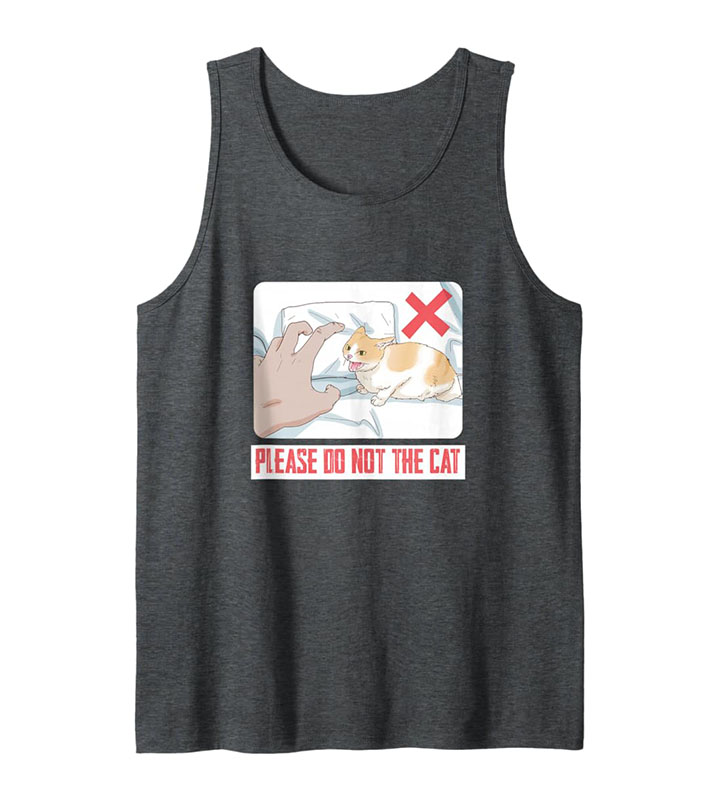
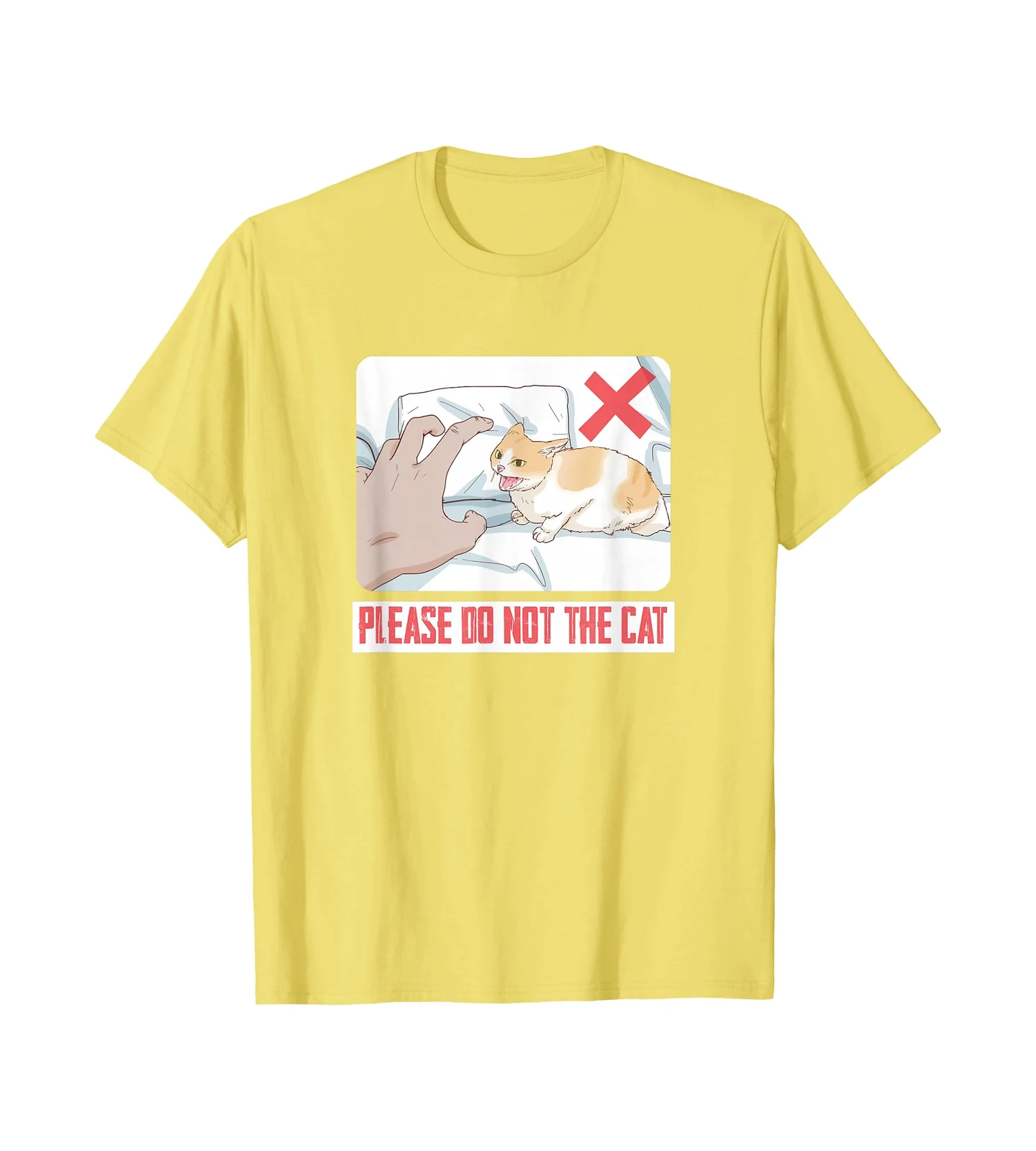
The Please Do Not the Cat meme is funny because it looks like a warning that forgot the most important part: the verb.
A hand reaches toward an angry-looking cat. A warning symbol says the action is wrong. Then the caption delivers the wonderfully incomplete instruction:
“Please do not the cat.”
Do not what the cat?
That missing word is the entire joke. The sentence sounds almost correct, but removing the verb turns an ordinary warning into strange internet nonsense.
The Please Do Not the Cat shirt is based on that familiar image and its deliberately broken sentence.
What Does “Please Do Not the Cat” Mean?
Grammatically, “Please do not the cat” is incomplete. The phrase do not normally needs an action after it.
You could say “Please do not touch the cat”, “Please do not bother the cat”, or “Please do not pet the cat.” Instead, the meme removes the action entirely.
That leaves the cat sitting where the verb should be.
The result sounds as though cat has somehow become an activity. Nobody knows exactly what it means to “the cat,” which is why the instruction becomes absurd.
In other words, the meme does not warn you against one specific behavior. It simply asks that, whatever you were planning to do, you absolutely do not the cat.
Where Did the Please Do Not the Cat Meme Come From?
The meme traces back to an edited WikiHow-style illustration showing a hand reaching toward an irritated cat. On September 29, 2019, the Facebook page WikiHow Image Macros posted the image with the caption “Please Do Not The Cat.”
The Know Your Meme history of Please Do Not the Cat identifies that Facebook post as the earliest documented version of the meme. The page specialized in turning unusual WikiHow illustrations into absurd image macros.
That distinction matters because the meme is sometimes described as a badly translated sign or accidental piece of broken English.
It was not.
The strange grammar was part of the parody.
Why WikiHow Images Became Meme Material
WikiHow illustrations have been used as meme material for years because they often show ordinary situations in unusually dramatic ways. Remove the original instructions, add a strange caption, and a practical drawing can suddenly look completely surreal.
Please Do Not the Cat fits that format perfectly. Even without the caption, the image already looks dramatic: a hand approaches a visibly unhappy cat while a warning symbol tells you something has gone terribly wrong.
Then the caption refuses to explain what the problem actually is.
That combination gives the image its strange authority. It looks like an instructional diagram, so your brain expects useful information. Instead, you receive a command that is grammatically useless.
How the Meme Spread Online
The original Facebook post spread quickly beyond the WikiHow Image Macros page. By the following day, the image had appeared in Reddit communities including r/ontheledgeandshit and r/ihadastroke.
Later reposts appeared in places such as r/comedyheaven, where intentionally awkward or nonsensical humor already had an audience.
By 2020, people were also creating variations of the format. Instead of merely reposting the original cat image, users began treating the sentence structure itself as the meme.
That was the important step.
“Please do not the cat” stopped being only one image and became a reusable way of writing nonsense.
The Missing Verb Is the Joke
Most jokes give you information. This one removes information.
The sentence begins normally with “Please do not…”, so the reader expects an action next. Instead, the sentence jumps directly to “the cat.”
That makes your brain briefly search for the missing word.
Was it supposed to say touch? Pet? Annoy? Pick up? Disturb?
The meme never answers.
Because the missing action could be almost anything, the phrase becomes funnier the longer you think about it. The warning feels extremely serious while refusing to tell you what behavior is forbidden.
Why “Do Not the Cat” Became Its Own Phrase
Once people understood the joke, they no longer needed the original image.
The phrase itself became enough.
Someone could post a cat video and comment “please do not the cat.” Another person could answer with variations such as “I will the cat” or “what if I the cat?”
That works because the original grammatical mistake creates a fake verb. Suddenly, cat can become something a person apparently does.
The internet loves that kind of language mutation. A sentence starts as nonsense, people repeat it enough times, and eventually everyone involved understands the joke even though the grammar remains completely broken.
Why the Cat Makes the Meme Better
The joke could theoretically work with another noun. However, the cat gives the image extra personality.
Cats already have a long history as internet characters. They can look annoyed, judgmental, confused, aggressive, or completely uninterested in whatever humans are doing around them.
The cat in this image looks especially unwilling to participate.
That expression makes the mysterious warning seem almost reasonable. You may not know what it means to “the cat,” but the cat clearly does not want you doing it.
Therefore, the image creates a strange agreement between the viewer and the animal: whatever the prohibited action is, perhaps it is better not to find out.
Is “Please Do Not the Cat” Broken English?
Technically, the sentence is grammatically broken. However, describing the meme as an accidental translation mistake misses the point.
The wording was deliberately constructed as absurd internet humor.
That makes it different from memes built around genuine mistranslations, misspelled signs, or accidental typos. Here, the missing verb is intentional.
The joke works because the caption imitates the tone of a serious warning while deliberately removing the information needed to understand that warning.
So yes, the grammar is wrong.
But it is wrong on purpose.
How People Use the Please Do Not the Cat Meme
Today, the phrase works as both a specific meme reference and a general piece of cat-related nonsense.
People can use the original image as a reaction. They can also write the phrase under photos or videos of cats, especially when the animal looks angry, uncomfortable, or suspicious of human attention.
Other variations play with the grammar itself. Once “the cat” becomes an imaginary action, the format can be expanded almost indefinitely.
That flexibility helped the joke survive beyond its original 2019 post. It no longer depends on people seeing the exact WikiHow-style image first.
The phrase now carries the reference by itself.
Why the Please Do Not the Cat Meme Still Works
The strongest memes are often simple enough to understand immediately but strange enough to remember later.
Please Do Not the Cat has both qualities.
The image is straightforward. The warning format is familiar. The sentence is short.
Then one missing verb breaks everything.
That gives the joke the same kind of absurd logic that powers a lot of internet humor: something is obviously wrong, everyone recognizes that it is wrong, and explaining it too carefully would only make it less funny.
The result is a phrase that sounds like an important instruction despite communicating almost nothing.
The Please Do Not the Cat Shirt
The Please Do Not the Cat shirt recreates the central elements of the meme: the cat, the reaching hand, the warning-style presentation, and the wonderfully incomplete instruction.
Those elements matter because the humor comes from seeing the phrase in the context of a warning. Without the visual setup, the sentence is strange. With the image, it becomes strangely official.
For people who know the meme, the reference is immediate. For everyone else, the design still presents a question that is almost impossible not to ask:
Do not what the cat?
The design also fits naturally among AmazeShirt’s Viral Meme Designs, where other internet references began as clips, images, quotes, and strange moments before becoming reusable online jokes.
Please, Whatever You Do, Do Not the Cat
The Please Do Not the Cat meme does not need a complicated punchline. It needs one cat, one reaching hand, and one sentence with a very important word missing.
The image began circulating in 2019 after WikiHow Image Macros posted the edited illustration. From there, the grammatical joke spread through Reddit, reposts, variations, and eventually the wider language of cat memes.
Years later, the instruction remains just as unclear.
Maybe you should not touch the cat. Maybe you should not annoy the cat. Maybe you should simply keep your distance.
Whatever the answer is, one rule remains:
Please do not the cat.