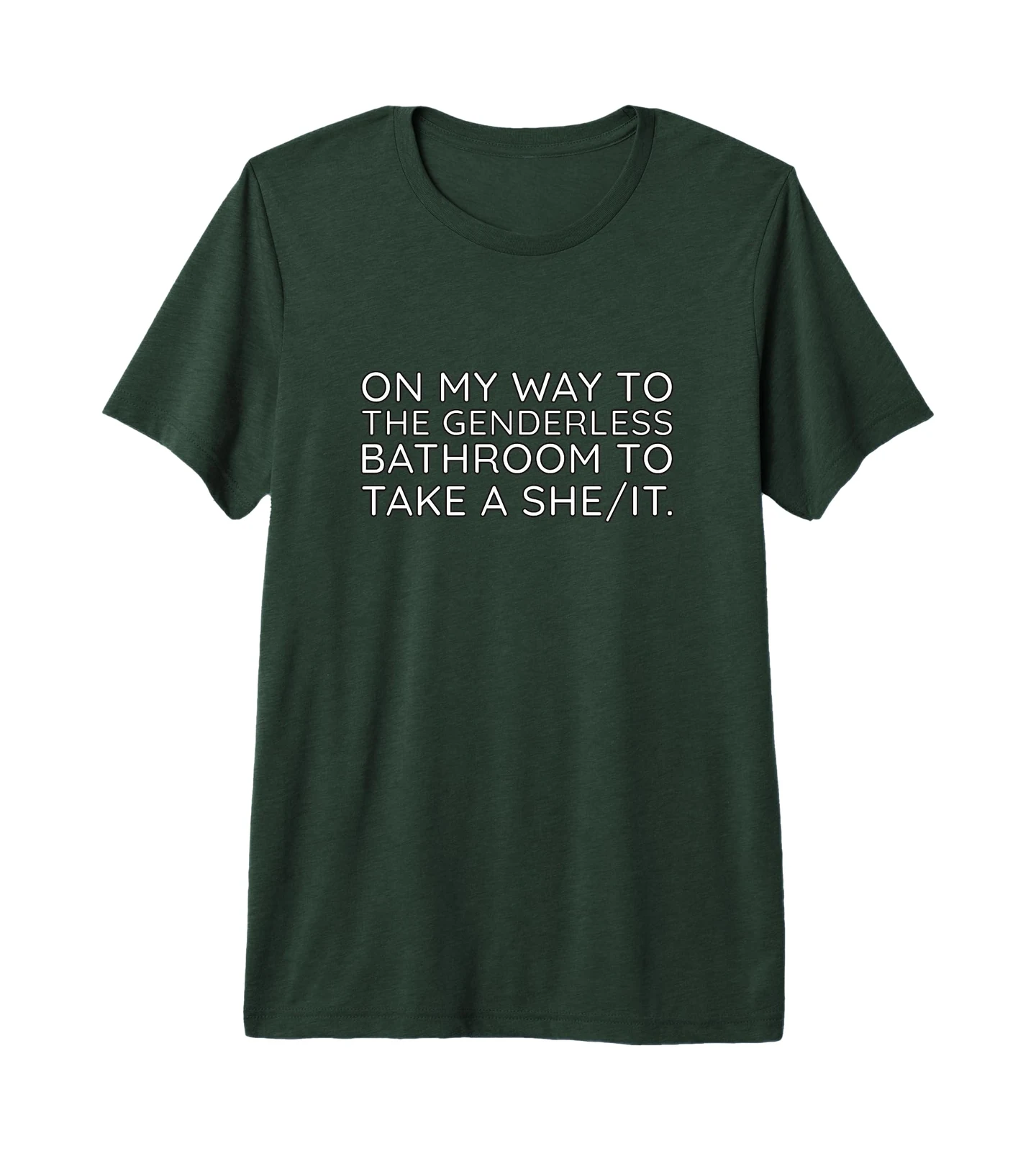
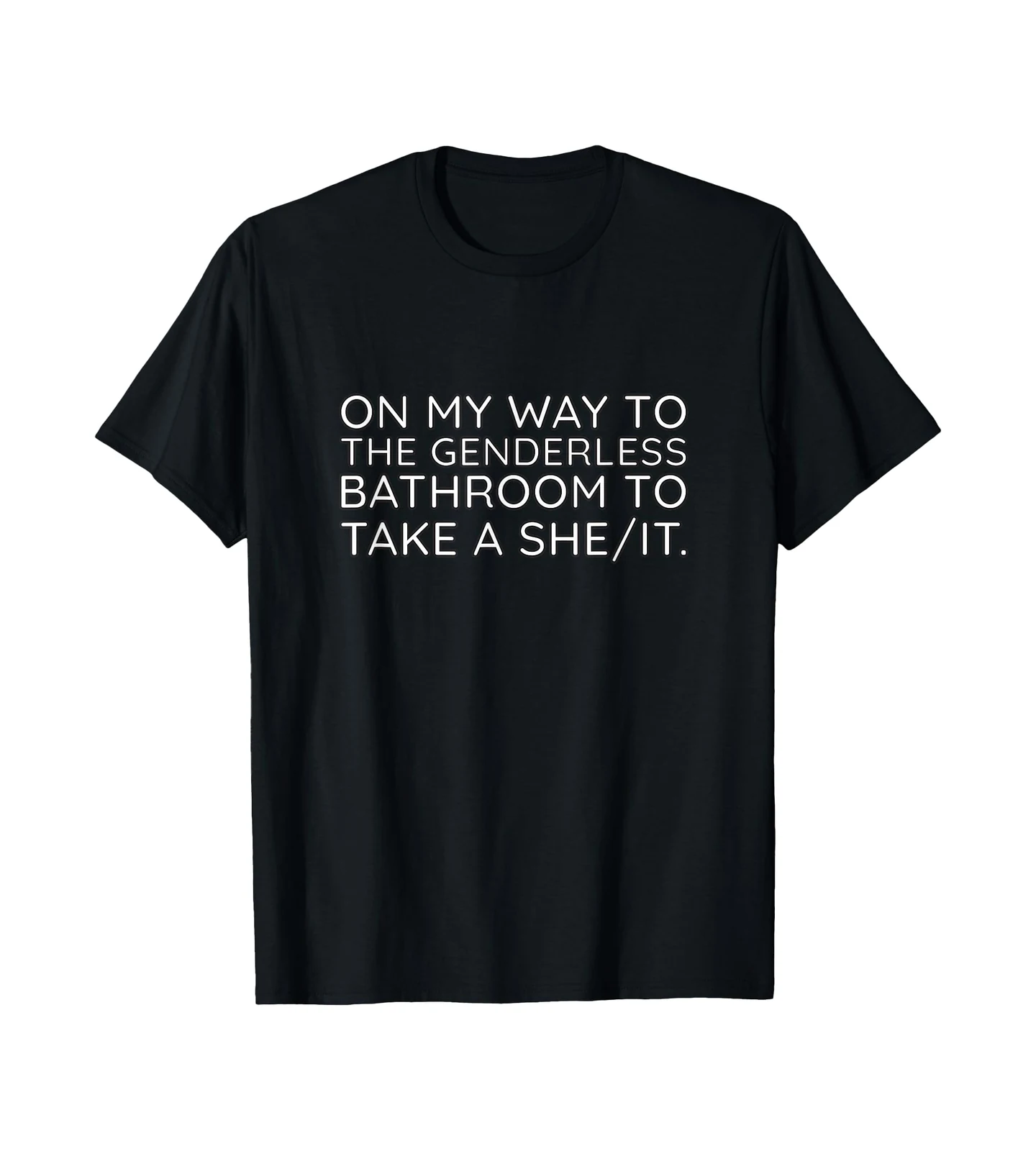
The genderless bathroom She/It shirt is built around a joke that takes a second to register. At first, the phrase looks like it is talking about pronouns and a genderless bathroom. Then you reach the final two words.
“On my way to the genderless bathroom to take a she/it.”
Read “she/it” quickly and the punchline becomes obvious. The two words run together and sound like “shit.”
That phonetic switch is the entire engine behind the genderless bathroom She/It shirt. The setup points your brain toward pronouns, while the bathroom context quietly prepares a completely different interpretation.
What Does “Take a She/It” Mean?
“Take a she/it” is a visual and phonetic pun. Written down, she and it look like two separate pronouns divided by a slash. Spoken quickly, however, they sound very close to the word “shit.”
That means the sentence has two ways to process it. Your eyes initially see pronoun-style wording, but your ears hear an ordinary crude expression about going to the bathroom.
The joke depends on that delayed recognition. You are supposed to read the phrase normally, reach “she/it,” and then realize what it sounds like.
In other words, the slash hides the punchline in plain sight.
Why Does the Joke Mention a Genderless Bathroom?
The bathroom setup is what makes the pun work so efficiently. Without it, “she/it” would still sound amusing when read aloud, but there would be much less reason for the sentence to lead there.
The phrase “genderless bathroom” prepares the reader to think about gender and pronouns. At the same time, the word “bathroom” prepares the other meaning of the punchline.
Therefore, both halves of the joke arrive at exactly the same place.
Your brain sees she / it and expects pronoun wordplay. Then the bathroom context makes the combined sound obvious.
That double setup is why the sentence works better than simply printing “she/it” by itself.
It Is a Pun Before It Is a Meme
It is tempting to assume that every phrase on the internet must come from one specific viral post, video, or creator. However, that does not appear to be necessary here.
The humor works as standalone wordplay. There is no character to identify, movie scene to remember, or famous interview required to understand the phrase.
That makes this design different from something like Me Gusta, This Is Fine, or Tony and Ezekiel. Those references point back to identifiable pieces of internet history.
By contrast, “take a she/it” succeeds because of language itself.
That is also consistent with the normal definition of a pun. The Cambridge Dictionary definition of a pun includes jokes that work because a word or phrase sounds like another word.
That is exactly what happens here.
How the “She/It” Wordplay Works
The joke has several small steps, even though most people process them almost instantly.
First, you read “On my way to the genderless bathroom.” That sounds like a straightforward statement about where someone is going.
Then the phrase introduces “she/it.” The slash encourages the reader to see two separate pronouns.
Finally, you hear the words together.
She + it.
She-it.
Shit.
Once that connection happens, the entire sentence changes. What looked like a statement about pronouns becomes a bathroom joke.
That small mental bait-and-switch is the punchline.
Why the Slash Matters
The slash may be the most important character in the whole design.
If the phrase simply said “she it,” the joke would be easier to spot. If it said the crude word directly, there would be no wordplay at all.
She/it creates the visual misdirection.
The formatting resembles the way combinations of pronouns can be written online. Therefore, the reader initially separates the two words rather than immediately sounding them out as one unit.
Then the rest of the sentence forces that second reading.
It is a tiny piece of punctuation doing a surprising amount of comedic work.
Why You Usually Get the Joke on the Second Read
This kind of wordplay works best when the first interpretation survives for a moment. If the punchline is obvious before you finish reading, there is no surprise.
Here, the sentence gives your brain a perfectly reasonable path to follow. You see a genderless bathroom, then pronoun-like formatting, so the wording appears internally consistent.
Only after you reach the end do you mentally say “she/it” aloud.
Then the other meaning appears.
That is why the design has strong “wait, did that actually say that?” energy. The reader effectively tells themselves the joke.
Is the Genderless Bathroom Shirt Political?
The phrase borrows language that also appears in cultural and political conversations. However, the actual mechanics of this design are much simpler.
The joke does not require a political argument to function. Its punchline is the sound created by putting she and it together in a bathroom sentence.
Different people may bring their own interpretations to the setup. Still, explaining the design as a detailed political statement gives the wording more ideological weight than the actual joke needs.
At its core, it is crude wordplay.
The bathroom establishes one meaning. The pronoun-style formatting establishes another. Then she/it connects them.
Why Crude Wordplay Works So Well Online
The internet has always rewarded jokes that can be understood quickly. A complicated setup may work in a comedy routine, but captions, memes, comments, and graphic designs usually have much less time.
This phrase solves that problem by putting the setup and punchline in one sentence.
It also has a strong read-aloud quality. Even if nobody actually says the words, readers tend to hear language internally while reading it.
That matters here because the visual joke is incomplete until “she/it” becomes a sound.
The result sits somewhere between a dad joke and adult bathroom humor. It is clever enough to require wordplay and stupid enough to work immediately once you notice it.
That combination is very internet-friendly.
The Genderless Bathroom She/It Shirt
The On My Way to the Genderless Bathroom to Take a She/It shirt keeps the design focused almost entirely on typography.
That makes sense because the words are the visual. There is no character, reaction face, or movie screenshot needed to communicate the joke.
The reader has to encounter the sentence in the correct order. First comes the genderless bathroom. Then comes she/it. Finally comes the realization.
A more complicated illustration could actually distract from that sequence. Instead, the simple text-based layout lets the punchline happen inside the viewer’s head.
The design fits alongside AmazeShirt’s other viral meme and internet-humor designs, although this particular shirt depends more on wordplay than on a documented viral character or clip.
Why the Joke Is So Simple
There really is not much lore to uncover here.
No dog is sitting in a burning room. No Ugandan television host is asking an unforgettable question. Achilles is not shouting outside Troy, and no Rage Face needs an origin story.
This one is just language misbehaving.
A slash separates two ordinary pronouns. A bathroom gives them context. Then your brain puts the sounds together and discovers the crude punchline hiding underneath.
That simplicity is the strength of the genderless bathroom She/It shirt.
You read it once.
You hear it.
And then you realize exactly what kind of trip to the bathroom this was always going to be.