“It’s a shame stupidity isn’t painful” has spent years circulating as the perfect reaction to somebody doing something spectacularly foolish.
However, the familiar internet wording hides an interesting detail.
The quote most reliably connected to Anton Szandor LaVey does not say “It’s a shame.”
His documented version is:
“It’s too bad that stupidity isn’t painful.”
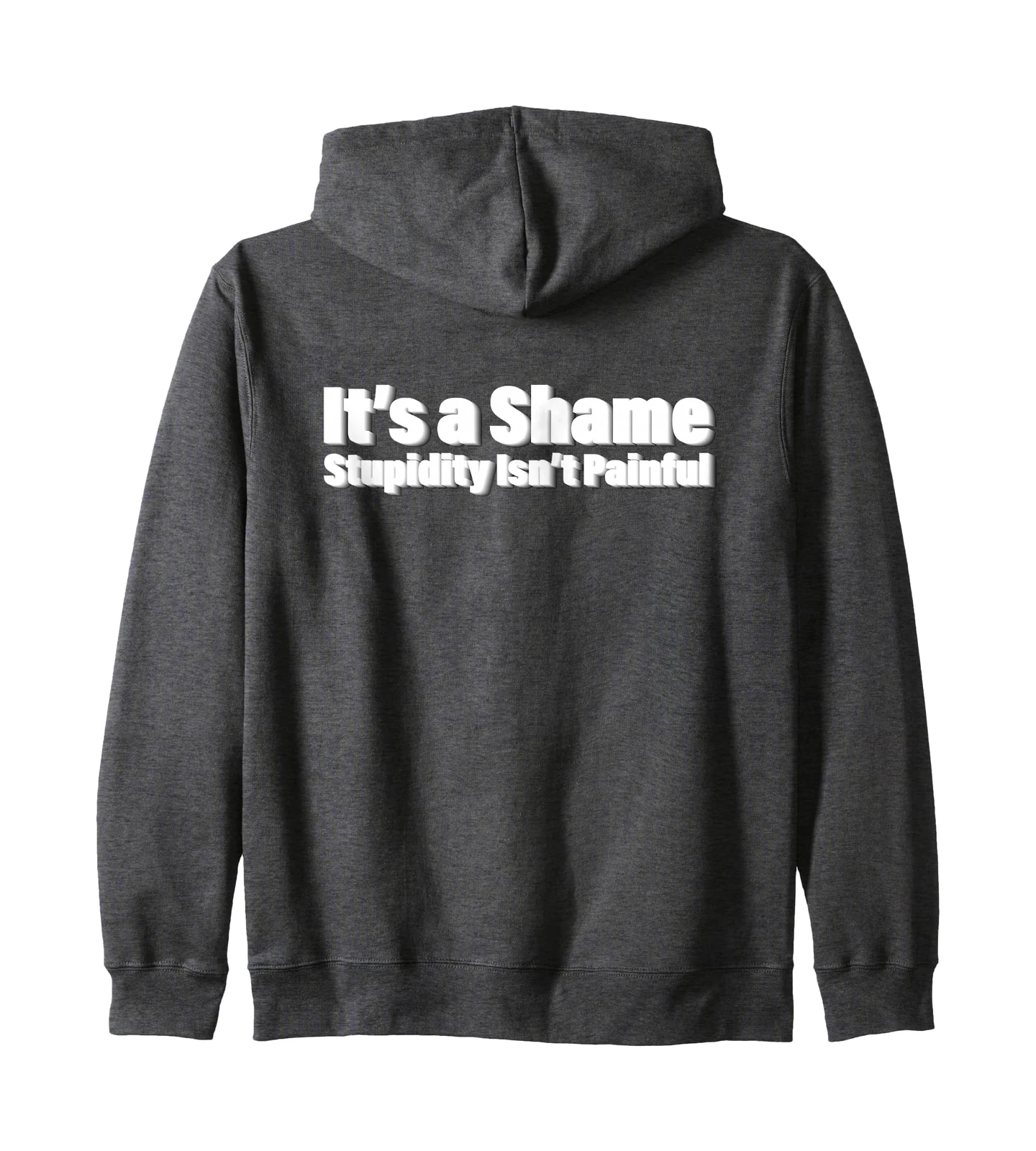
The It’s a Shame Stupidity Isn’t Painful design uses the popular variation of an idea LaVey published in 1987.
Who Said “Stupidity Isn’t Painful”?
The most clearly documented source is Anton Szandor LaVey, founder of the Church of Satan.
In 1987, LaVey published a short text called The Nine Satanic Sins. The first item on his list was stupidity.
While discussing it, he wrote:
“It’s too bad that stupidity isn’t painful.”
He then continued by distinguishing ignorance from what he considered deliberate or socially encouraged stupidity.
Therefore, the basic quote is not merely an anonymous internet slogan. It has a traceable source.
Why Does the Shirt Say “It’s a Shame” Instead?
Quotes rarely remain perfectly stable once they enter popular culture.
People paraphrase them, shorten them, alter punctuation, and substitute similar words. Eventually, the variation can become more familiar than the original.
That appears to have happened here.
“It’s a shame stupidity isn’t painful” preserves exactly the same idea while replacing LaVey’s “It’s too bad that…” with a smoother variation.
Quote websites frequently attribute both versions to LaVey, but the 1987 text supports the “too bad” wording directly.
What Are The Nine Satanic Sins?
The title may sound dramatic, but the list is primarily a set of behaviors LaVey believed people should avoid.
He included stupidity, pretentiousness, solipsism, self-deceit, herd conformity, lack of perspective, forgetfulness of past orthodoxies, counterproductive pride, and lack of aesthetics.
Stupidity appears first and receives especially blunt treatment.
LaVey calls it the cardinal Satanic sin and argues that society often rewards people for following what they are told without examining it critically.
Then comes the memorable wish that stupidity caused physical pain.
The Quote Is Older Than Modern Meme Culture
This distinction is important because the line sometimes looks like a modern sarcastic meme written specifically for shirts and social media.
Instead, the documented version dates to 1987.
That places it well before Facebook, Twitter, Reddit, image macros, and the modern meme ecosystem.
Internet culture later gave the sentence a much larger collection of contexts.
Why the Quote Became Perfect Reaction-Meme Material
The idea translates effortlessly to everyday frustration.
Someone ignores an obvious warning.
A person performs a dangerous stunt and immediately discovers why it was dangerous.
A coworker creates a problem that did not need to exist.
Somebody confidently demonstrates that they have misunderstood something fundamental.
At that point, the sentence practically writes itself:
It’s a shame stupidity isn’t painful.
The Joke Imagines Immediate Consequences
The line works because stupidity often does not produce instant feedback.
People can make poor decisions without immediately discovering that they were poor decisions. Sometimes somebody else deals with the consequences instead.
The quote imagines a much simpler system.
Make a sufficiently foolish decision?
Ouch.
Lesson delivered.
That imaginary connection between stupidity and pain gives the sentence its dark humor.
Why Misquoted Versions Can Become More Famous
Popular quotations frequently develop several forms.
A small wording change can make a sentence easier to remember, fit better on an image, or sound more natural to a new audience.
After enough repetition, people stop noticing that a variation exists.
That does not necessarily make the later wording fraudulent. However, it does matter when discussing historical origin.
In this case, the distinction is straightforward:
LaVey’s documented wording: “It’s too bad that stupidity isn’t painful.”
Popular variation: “It’s a shame stupidity isn’t painful.”
Did Anton LaVey Invent the Entire Idea?
We can confidently document LaVey using the “too bad” version in 1987.
That does not automatically prove nobody expressed a similar idea earlier.
Short observations about stupidity, pain, and consequences have existed in many forms, and searching for an absolute first human use is much harder than establishing a reliable published source.
Therefore, the careful claim is that LaVey is the documented source most strongly associated with this wording, not that he was necessarily the first person in history to imagine stupidity being painful.
The Phrase Became Detached From LaVey
Most people using the line online are not making a statement about Satanism.
They may not even know the attribution.
The sentence works independently because the joke requires no knowledge of its author. It became a sarcastic reaction to foolish behavior and circulated through quote images, forums, social media, merchandise, and everyday conversation.
As a result, the phrase now has a cultural life much larger than its original document.
The It’s a Shame Stupidity Isn’t Painful Shirt
The It’s a Shame Stupidity Isn’t Painful shirt uses the common “shame” variation rather than LaVey’s exact 1987 wording.
That makes it better understood as an adaptation of the famous quote than a verbatim reproduction.
The design focuses on the sarcastic idea itself: life might be considerably more educational if foolish decisions supplied immediate physical feedback.
It fits naturally among AmazeShirt’s Viral Meme Designs and internet one-liners.
Stupidity Remains Unfortunately Painless
Almost four decades after LaVey published his version, the phrase remains useful because people have not stopped doing remarkably foolish things.
The wording has changed slightly.
The platforms have changed completely.
The frustration behind it remains familiar.
Unfortunately, stupidity still does not reliably hurt.
And yes, sometimes that really does seem like a shame.