The Schrödinger’s cat meme has spent decades trapped between quantum physics and people making jokes about an understandably angry cat.
The original thought experiment imagines a cat sealed inside a box where its fate becomes connected to a random quantum event. In the famous simplified version, quantum mechanics seems to leave the cat represented as both alive and dead until the system is observed.
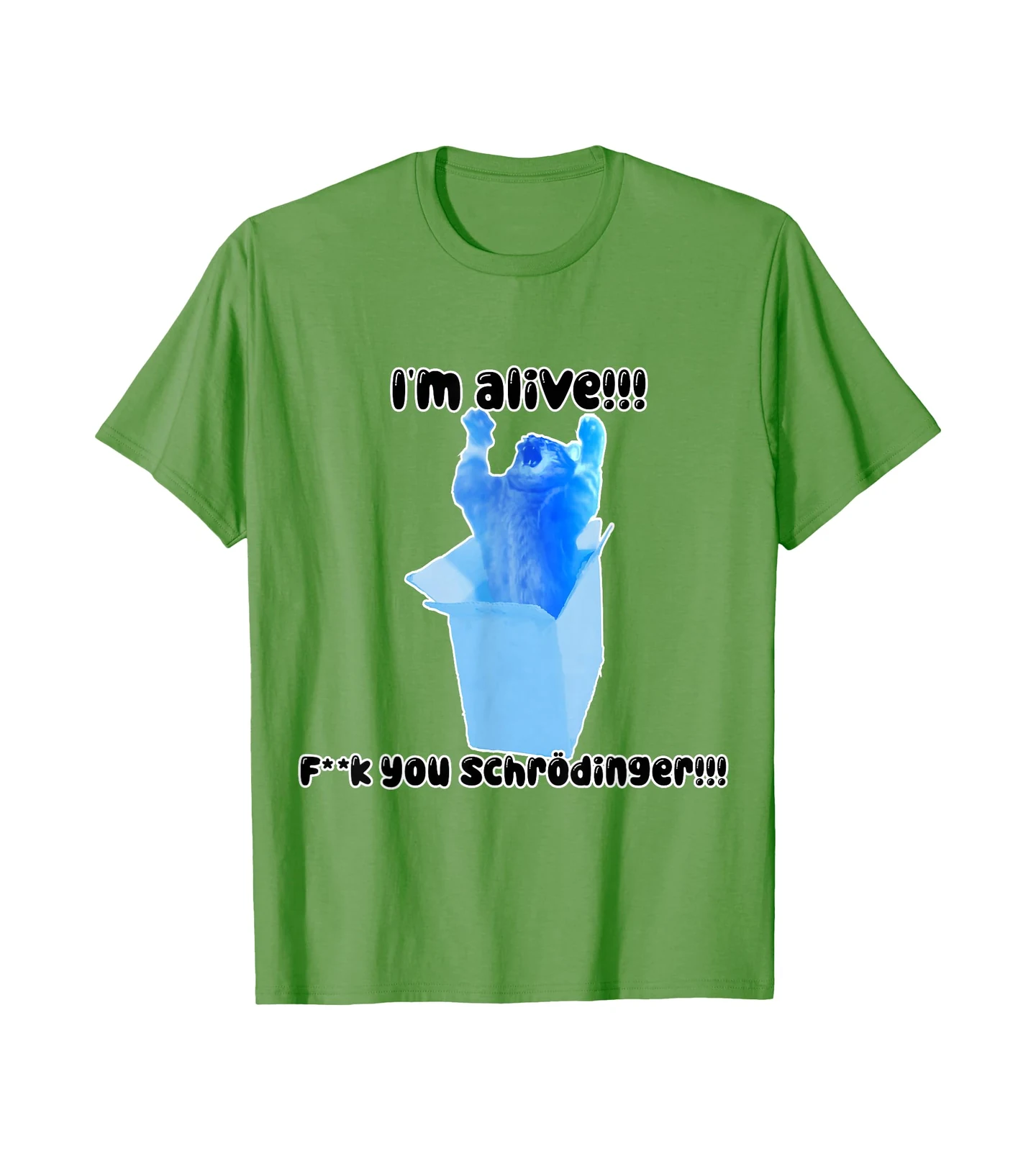
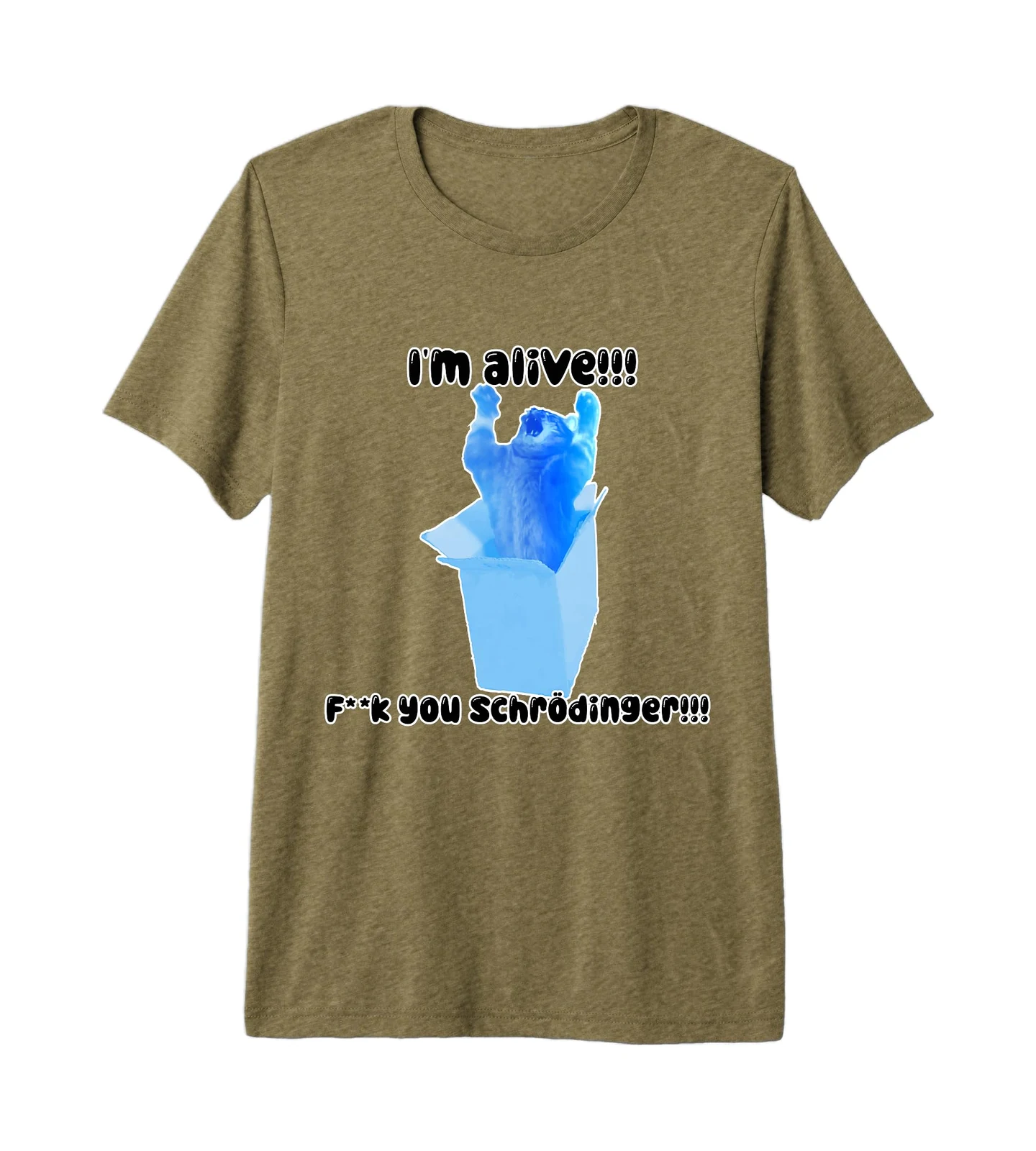
The I’m Alive… F You Schrödinger design proposes a much less subtle solution.
The cat comes out alive.
And it would like a word with the physicist responsible for the entire situation.
Who Was Erwin Schrödinger?
Erwin Schrödinger was an Austrian physicist and one of the central figures in the development of quantum mechanics.
His wave equation became foundational to the field, and he shared the 1933 Nobel Prize in Physics with Paul Dirac.
Yet outside physics classrooms, his name is probably most famous because of one imaginary cat he placed in an imaginary box in 1935.
No actual cat needed to participate.
What Is the Schrödinger’s Cat Thought Experiment?
Schrödinger imagined a sealed container holding a cat together with a mechanism connected to radioactive decay.
If the radioactive event occurs, a detector activates a mechanism that releases poison and kills the cat. If the decay does not occur, the cat remains alive.
The radioactive event is quantum mechanical. Under a straightforward extension of quantum superposition to the entire system, the description seems to entangle the atom and the cat into a state involving both possible outcomes before observation.
The American Physical Society’s explanation of Schrödinger’s cat traces the thought experiment to 1935 and its use in illustrating the tension between quantum rules and ordinary macroscopic experience.
Was Schrödinger Seriously Claiming Cats Are Both Alive and Dead?
This point is frequently lost in simplified explanations.
Schrödinger was not proposing that putting household pets into boxes was a sensible experiment, nor was he happily announcing that ordinary cats literally occupy obviously contradictory everyday states.
The scenario was designed to expose how strange quantum mechanics becomes when its formalism is extended from microscopic events to familiar macroscopic objects.
In other words, the absurdity was part of the point.
Why Use a Cat?
A quantum particle existing in a superposition can feel abstract. A cat is not abstract.
Everyone understands the difference between a living animal and a dead one. Connecting that everyday distinction to the uncertain state of a radioactive atom makes the conceptual problem impossible to ignore.
Instead of debating symbols on paper, the thought experiment asks readers to imagine that an apparently microscopic ambiguity has been amplified into the fate of an entire animal.
That is precisely why the example has survived for so long.
Does Opening the Box Kill or Save the Cat?
Popular explanations sometimes make the observer sound almost magical, as though a human glance personally determines whether the cat lives.
The actual measurement problem is more complicated than that. Different interpretations of quantum mechanics explain measurement, superposition, and macroscopic outcomes in different ways.
For meme purposes, however, the familiar simplified version is enough: before observation, the cat is associated with both possible outcomes; opening the box reveals one.
That is the cultural version the joke attacks.
The Cat Has Had Enough of Being a Physics Example
The AmazeShirt joke flips the thought experiment from the cat’s perspective.
Physicists can debate interpretations as much as they want. The cat has apparently resolved the situation personally.
It is alive.
More importantly, it is not particularly grateful to Schrödinger for putting its hypothetical life at the center of one of physics’ most famous paradoxes.
The profanity works because the cat finally gets a voice in an experiment where everyone else has spent decades discussing its possible death.
How Schrödinger’s Cat Escaped Physics
The thought experiment became one of the rare pieces of quantum mechanics recognized far outside scientific circles.
Books, television shows, cartoons, games, comics, internet posts, and merchandise constantly reuse the idea. Sometimes it is treated seriously. Often, people simply invent new ways for the cat to object.
The concept is unusually meme-friendly because the basic setup can be explained in one sentence: there is a cat in a box, and quantum mechanics makes its status weird.
From there, internet humor does the rest.
Why Science Memes Like Schrödinger’s Cat Work
The strongest science jokes reward a little background knowledge without requiring a physics degree.
Someone who knows only the famous “alive and dead” version can understand the design immediately. Someone familiar with the history gets the additional joke that Schrödinger himself introduced the example to highlight a problem with treating macroscopic systems that way.
The more context you know, the more ridiculous an angry surviving cat becomes.
The I’m Alive F You Schrödinger Shirt
The I’m Alive F You Schrödinger shirt gives the thought experiment a definitive ending.
No mathematical notation is necessary. No Copenhagen interpretation meeting needs to be scheduled.
The cat is alive, irritated, and apparently capable of communicating exactly how it feels about the whole thing.
Schrödinger’s Cat Finally Gets the Last Word
Schrödinger created the thought experiment in 1935 to illustrate a deep problem in interpreting quantum mechanics.
Nearly a century later, the paradox is still discussed by physicists and philosophers.
The cat, meanwhile, has a simpler position.
It survived.
And it has had enough.
I’M ALIVE.