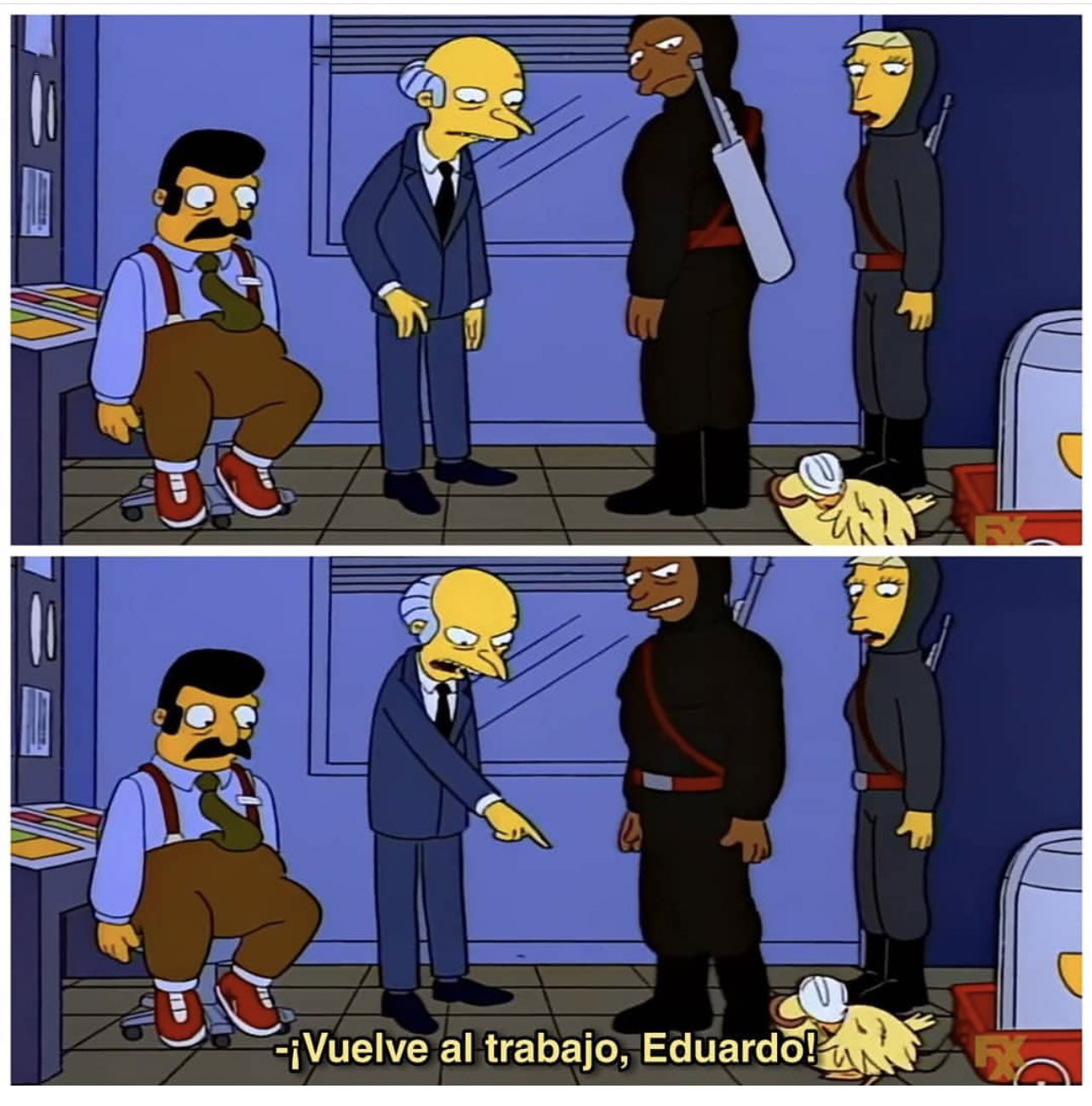

“¡Vuelve al trabajo, Eduardo!” is one of those tiny Simpsons jokes that became disproportionately memorable in Latin American Spanish.
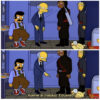
Mr. Burns has just been ordered to change the Springfield Nuclear Power Plant’s terrible employment practices. He reluctantly agrees to hire a woman while insisting that there is absolutely nothing wrong with the way he runs the plant.
Then a duck wearing a work helmet strolls past pulling a wagon.
Burns immediately orders him back to work.
The absurd little employee is the reference behind the Vuelve al Trabajo Eduardo design.
Which Simpsons Episode Has Eduardo the Duck?
The scene appears in Season 5, Episode 9, “The Last Temptation of Homer,” originally broadcast on December 9, 1993.
The main plot is remembered for Homer meeting his new coworker Mindy Simmons. However, the reason Mindy is hired begins with a much shorter joke about the nuclear plant’s labor practices.
Department of Labor inspectors descend on the plant and discover exactly the kind of workplace anyone familiar with Mr. Burns should expect.
The Simpsons Archive capsule for “The Last Temptation of Homer” preserves the original English scene.
Why Is the Department of Labor at the Nuclear Plant?
The inspectors discover a spectacular collection of violations.
Burns attempts to defend employees who obviously should not be working there under normal circumstances. The investigators eventually tell him that, at minimum, he must reverse the plant’s sexist employment policies and hire a woman.
Burns reluctantly agrees.
However, he insists that he still stands by his hiring policies.
That statement is immediately contradicted by the next thing we see.
The Duck Is the Punchline
A quacking duck wearing a hard hat enters the scene while pulling a small wagon.
Burns instantly orders the duck back to work.
No explanation is provided for why the Springfield Nuclear Power Plant employs a duck. Nobody asks whether the duck receives a salary. The show simply presents this as further evidence that Burns’s employment policies are exactly as terrible as the inspectors believe.
The joke lasts only seconds, but the visual is difficult to forget.
In English, Eduardo Isn’t Eduardo
Here is where the localization becomes particularly interesting.
In the original English dialogue, Burns calls the duck Stuart and orders him back to work.
In the Latin American Spanish dub, the moment became the familiar “¡Vuelve al trabajo, Eduardo!”
So the name Eduardo is not a fan invention or a mistranscription of the English episode. It belongs to the dubbed version through which millions of Spanish-speaking viewers encountered the scene.
Why Dubs Create Their Own Memes
Popular television does not always produce identical cultural references in every language.
A translated line can develop its own rhythm, wording, and associations. When people grow up hearing the dubbed version, that version becomes the quote they remember and repeat.
Latin American Simpsons fandom is especially full of examples because the series became deeply embedded in Spanish-language popular culture.
Eduardo is a perfect case: an extremely minor joke becomes locally recognizable through the dub.
Why “Vuelve al Trabajo Eduardo” Became Workplace Humor
The phrase has another advantage: it functions perfectly outside the episode.
Someone named Eduardo stops working?
Vuelve al trabajo, Eduardo.
A coworker becomes distracted?
They have temporarily become Eduardo.
A duck appears wearing protective equipment and pulling industrial cargo?
At that point the reference has essentially recreated itself.
The Joke Is Really About Mr. Burns
Although the duck gets the visual attention, the target of the joke is Burns.
He has just been confronted by government officials over abusive and discriminatory employment practices. He promises one minimal change while defending everything else.
Then the audience discovers that one of his workers is literally a duck being ordered to continue manual labor.
The timing exposes the absurdity of Burns’s defense without requiring anyone to explain it.
Why the Scene Is Classic Simpsons Writing
Early Simpsons episodes often stack small jokes around the main plot. A gag may last only a few seconds yet contain enough visual and verbal information to survive independently for decades.
The hard-hat duck is exactly that kind of joke.
He is not important to Homer and Mindy’s story. He does not need a subplot. The scene simply establishes that Burns runs such a ridiculous workplace that even a duck may be part of the exploited labor force.
Then the episode moves on.
The Vuelve al Trabajo Eduardo Shirt
The Vuelve al Trabajo Eduardo shirt focuses on the Spanish-language version of the gag, pairing the phrase with the little working duck.
That makes it especially specific to viewers who remember The Simpsons through its Latin American dub.
It belongs naturally alongside AmazeShirt’s Cult Classic TV designs, but it also represents something more specific: a reference whose most memorable form depends on localization.
Stuart in English, Eduardo in Spanish
Both versions point to the same exhausted little duck.
English-language viewers know Burns ordering Stuart back to work. Latin American viewers may hear Eduardo immediately.
The gag survives either way because the visual remains absurd.
A duck is working at a nuclear power plant.
And apparently he has been standing around long enough.
¡Vuelve al trabajo, Eduardo!